Domino’s Pizza
The Risky Promise That Built an Empire
In 1960, Tom Monaghan and his brother James purchased a small local pizzeria in Michigan (USA): DomiNick’s. Very quickly, James decided to leave the venture, and Tom continued alone. His pizzeria was built on a very traditional model:
A place offering ordinary pizzas, local service, and… frankly, no real differentiation from competitors. Just a simple food business that allowed him to pay the bills.
Five years later, as part of a franchising strategy, he decided to rename the pizzeria Domino’s Pizza. He was far from imagining that 60 years later, his brand would be present in more than 20,000 locations worldwide.
A painful truth: his pizzeria was… ordinary
Despite the new name and his ambition to franchise, Tom quickly realized he wasn’t standing out. Many competitors were active in his region, and nothing truly made him unique. It was an alarming realization that pushed him to find his promise. What could possibly make him different?
By analyzing competitors and the pizzeria market, he observed three very concrete things:
Customers typically order when they’re in a hurry. A night with friends, an improvised dinner in front of a game on TV, a student study session, etc.
Delivery delays create massive frustration. The pizza may be great, but the bitter taste of waiting is what customers remember.
All competitors claimed to have “the best pizza in town.” It was the only promise being promoted—and it had become meaningless in customers’ eyes.
From this, Tom understood that the real tension to unlock wasn’t taste—it was waiting time. We’ll explore marketing tension in another article, but it’s one of the most powerful ways to generate rapid traction.
The breakthrough
In 1973, Tom made a bold move. He differentiated with one very simple promise: “Your pizza delivered in 30 minutes or it’s free.” This wasn’t a short-term campaign. It became an internal operational rule. An official declaration and a public commitment.
Domino’s guaranteed delivery within 30 minutes—and if the deadline wasn’t met, the pizza was free.
Something almost magical happened: people started testing the promise. A weak promise doesn’t invite verification. A strong one attracts scrutiny.
Used to competitors’ delays, customers deliberately tested Domino’s. During the most stressful moments—bad weather, snowstorms, peak demand, busy evenings—some customers ordered specifically to see if Domino’s would keep its word.
The company knew it had no room for error. A broken promise can quickly become a direct path to bankruptcy.
So Domino’s completely transformed its operating model to uphold the promise:
Menus offered fewer variations
Pizzas were designed for faster cooking
Store locations followed strict strategic implementation
Internal processes were standardized
The company culture became obsessed with timing
And then… Tom watched his company explode.
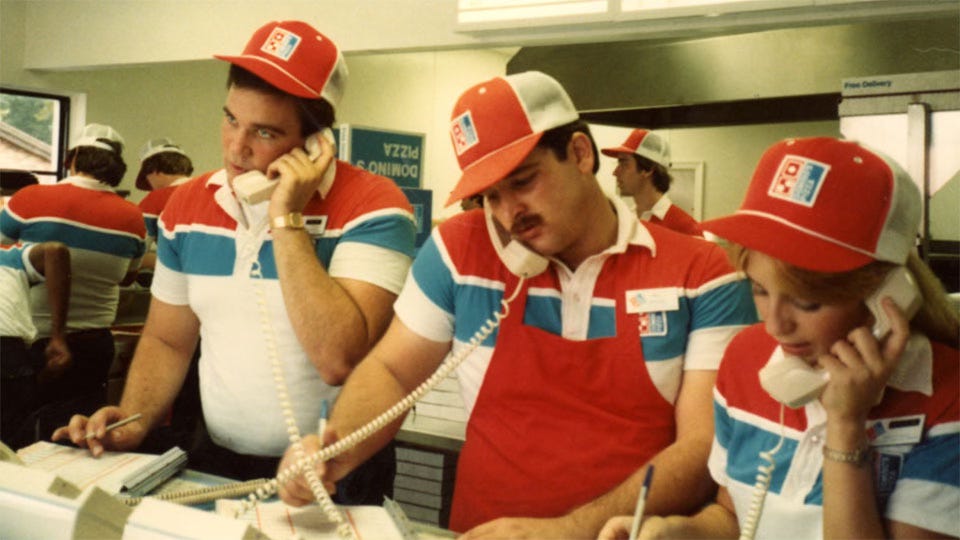
By 1978, 200 locations were delivering pizzas daily. Five years later, that number reached 1,000. By 1989, Domino’s Pizza had more than 5,000 locations worldwide.
When the promise became dangerous
But as the saying goes, all good things come to an end. When Tom created the promise, he never imagined it could become dangerous.
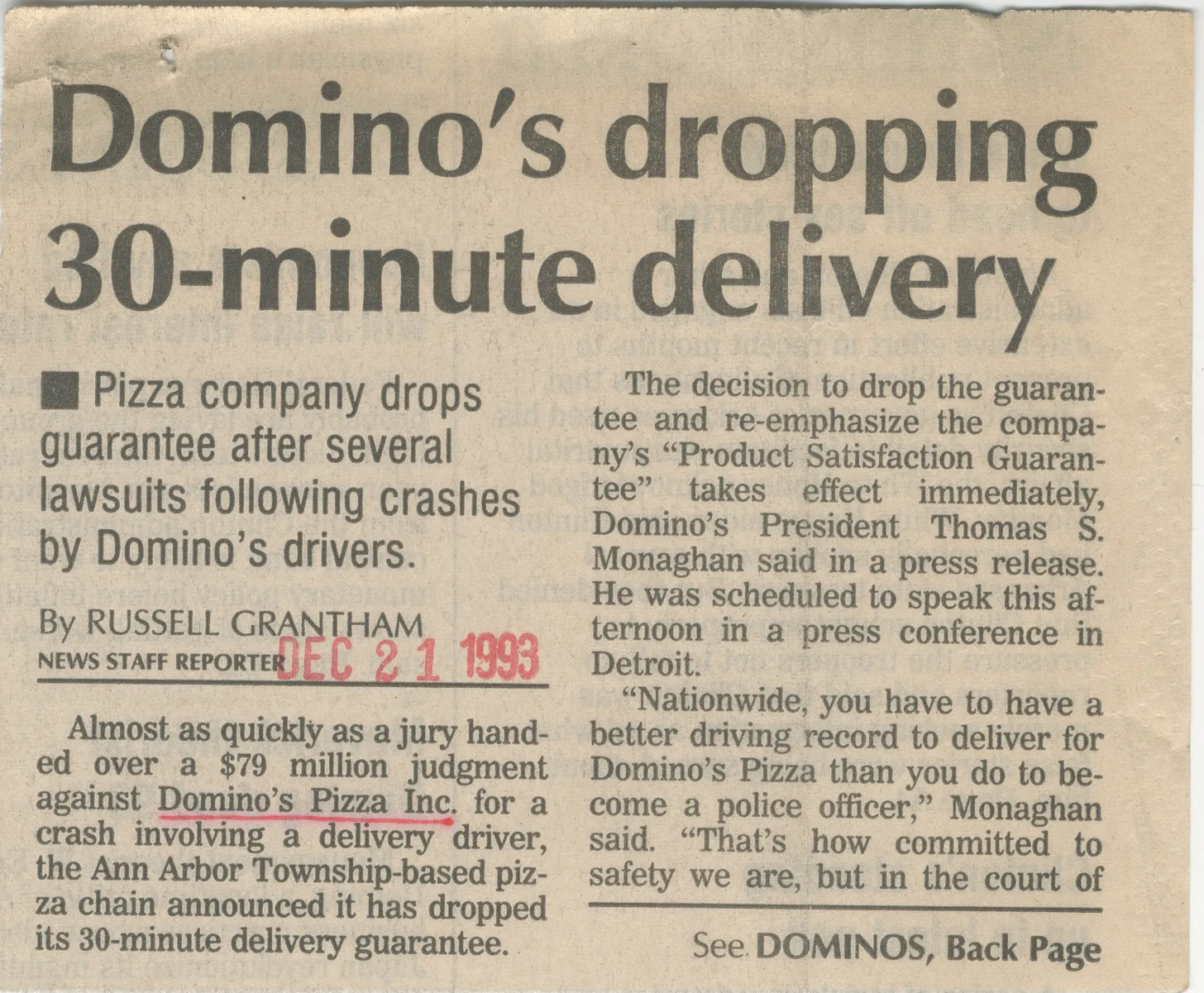
Road accidents involving delivery drivers were increasing. Numerous lawsuits were filed in the United States, and the company was accused of encouraging reckless driving.
The promise, once the engine of growth, had become a legal and human risk.
In 1993, Domino’s officially abandoned the 30-minute delivery guarantee in the United States. The company explained the decision to customers, citing employee safety, corporate responsibility, and long-term consistency.
However, instead of replacing the promise with an empty slogan or pivoting toward taste and quality positioning, Domino’s understood something crucial: the promise had been a tool. The real value lay in the system it had built around it.
Massive investment in tech and data
The 30-minute promise disappeared—but the culture of speed remained. The processes remained. Teams were still trained to deliver fast.
In the early 2000s, Domino’s began investing heavily in technology. Gradually, it became a tech company that sells pizzas.
It was among the first to offer online ordering and launched:
Highly optimized mobile applications
A real-time Pizza Tracker
Data analysis and logistics routing for ever-faster deliveries
They replaced the verbal 30-minute promise with real-time proof. It’s important to remember that this was the early 2000s—long before platforms like Uber Eats or Deliveroo became standardized.
Today, Domino’s Pizza operates close to 20,000 locations worldwide and has established itself as the global leader in pizza delivery and takeaway. And it all began with a promise the company was determined to honor—at any cost.
A brand promise is a powerful differentiation tool. But it can also become dangerous. If it isn’t—or is no longer—respected, your entire reputation can collapse.
The real lesson of Domino’s Pizza
The story of Domino’s Pizza isn’t about pizza. It’s about a promise used as a structural lever. The 30-minute guarantee was never designed to inspire dreams.
It was designed to force difficult decisions at every level of the company.
It forced Domino’s to:
- Simplify its offering
- Standardize its processes
- Optimize its logistics
- Align its entire internal culture around one clear objective
The question to ask today
The real question isn’t:
What promise can we display?
But rather:
What promise would we be willing to fund every single day—until it transforms our company?
That’s precisely how strong brands are built. If your promise doesn’t put you under pressure, it may not be a very good promise 😉
DARE is a branding and consulting agency based in Switzerland, in Forel (Lavaux). Since 2018, we have been supporting brands in their launch or refresh through an approach rooted in entrepreneurship, collective intelligence, and real-world feedback.
At DARE, every project truly matters. That is why we only take on one project per month. More information www.madebydare.com.
Thank you for reading DARE Inside ! Subscribe here for free to receive new posts.
© 2025 lagencedare