The Detail That’s Killing Your Brainstorms (And Costing You Money)
After organizing more than 500 brainstorms with companies of all sizes, we’ve learned one thing: ideas are never the real problem.
Over the years, we’ve worked with organizations such as Geneva Airport, Firmenich, Puma, and Groupe Mutuel. We’ve helped define corporate values, imagine products for upcoming launches, structure innovation strategies, design creative campaigns, and redefine long-term visions.
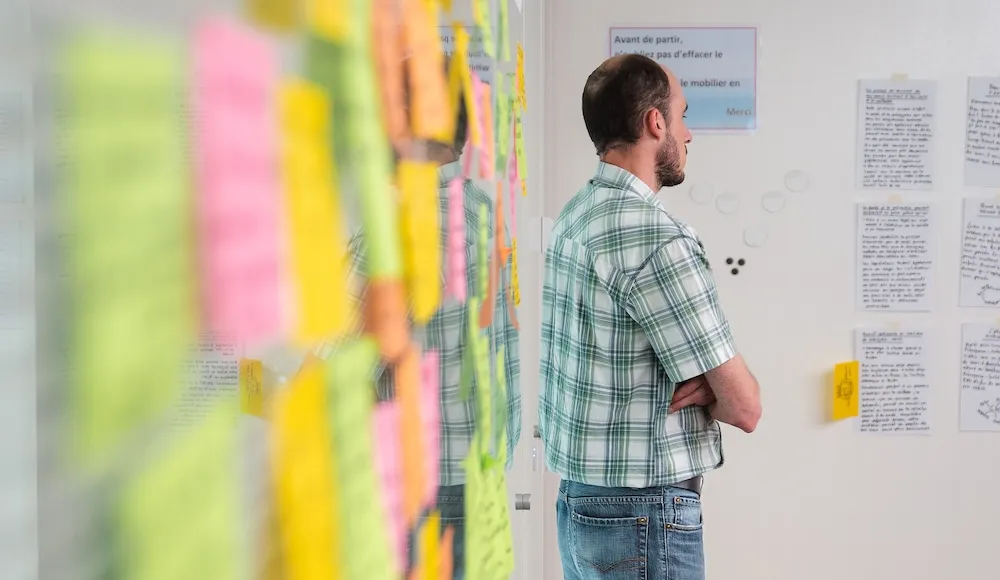
Entire rooms covered in Post-its. Walls filled with concepts. Whiteboards packed with ambitious ideas.
And yet, whenever the exercise went off track, it was never due to a lack of intelligence, experience, or inspiration.
It was because of one invisible detail.
Ego.
The illusion of a creative problem
Many companies believe their brainstorms fail because:
Teams lack boldness,
Ideas are too weak,
Time is poorly managed,
Employees aren’t creative enough.
A room can be filled with brilliant profiles, technical experts, seasoned strategists… and still produce average ideas.
Why?
Because collective creativity is a deeply psychological exercise.
In a brainstorming session, it’s not just ideas that circulate. There are statuses. Power dynamics. Glances. Implicit validations. Emotions. Meaningful silences.
And above all… egos.
The invisible hierarchy
Picture a room. Around the table: the executive team, a few senior managers, operational staff, and juniors.
Officially, everyone is invited to contribute. But subconsciously, everyone knows there’s a hierarchy. Even if no one says it. Even if no one enforces it.
The mere presence of a CEO can shift group dynamics. Some people will try to please. Others will self-censor. Some will wait for “the right answer” to be given. Others will defend their idea at all costs to prove their legitimacy.
The brainstorm becomes a space for social expression more than creative exploration.
That’s the precise moment when creativity starts to die and ego takes control.

Self-censorship and the search for approval
We’ve seen it dozens of times:
A slightly radical idea is introduced.
Silence.
A glance toward leadership.
A micro-reaction.
And the idea disappears.
Not because it was bad.
But because it was uncomfortable.
In many companies, brainstorms are actually exercises in social alignment. People adjust their speech based on what they believe is acceptable. More introverted profiles fade away. More extroverted profiles take up space. More dominant personalities impose their vision. Gradually, the diversity of ideas collapses.
What you end up with are reasonable concepts. Acceptable. Polished.
But rarely differentiated. And yet the purpose of a brainstorm is to tap into collective intelligence to generate ideas that truly stand out.
What we learned after 500 brainstorms
Over time, we understood that our role wasn’t simply to facilitate a brainstorming session. It was to create a psychological environment where ego loses its power.
Our work isn’t just creative mechanics. It’s human and emotional mechanics.
So we defined four simple rules that we systematically repeat at the beginning of every session:
1 - There are no bad ideas.
Every idea is worth sharing. Even the unrealistic ones. Even the absurd ones. They always serve as a springboard for further thinking.When a room understands it won’t be judged, it breathes.
2 – No one is right, no one knows.
This sentence can feel destabilizing. That’s intentional. It helps calm overly dominant profiles—those who arrive convinced they already have the answer.
A brainstorm is not a competition about who’s right. It’s a space for exploration.
3 – Once spoken or written, an idea no longer belongs to you.
This is probably the most powerful rule of all.
As soon as an idea is shared, it becomes collective. It can be challenged, transformed, completed—without being perceived as a personal attack.
This prevents excessive attachment and ego-driven defensiveness.
4 – There is no hierarchy in a brainstorm.
Just brains thinking collectively.
For this rule to work, it cannot be implicit. It must be said. Out loud. In front of everyone.
Putting leadership at the right level
We always take time to brief executives beforehand. Their presence can be extremely beneficial… but it can also intimidate teams.
We raise awareness about posture, listening, and the silent impact of their reactions.
Then, at the beginning of the session, we clearly state the rules in front of the entire group.
Adapting methods to include everyone
Another common brainstorming trap is believing that one method fits all.
Some people are brilliant verbally. Others need time to structure their thoughts.
Some improvise. Others think deeply before speaking.
If you don’t vary the exercises, you unconsciously favor a specific personality type.
Sometimes we begin with open discussions where everyone speaks freely. Then we shift.
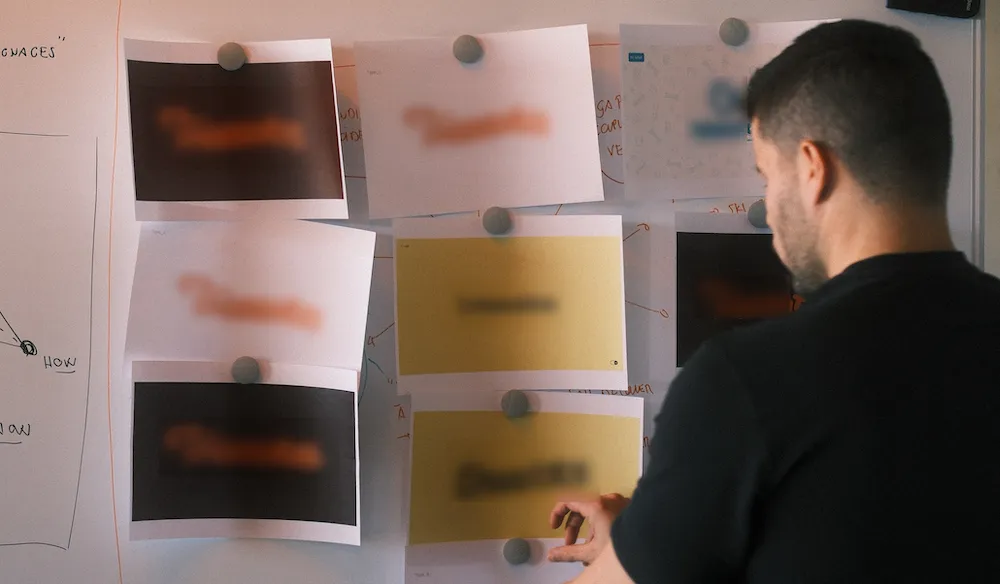
We ask each person to write their ideas on Post-its, without explanation. We collect and stick them to the wall ourselves—so no one knows who wrote what.
Then we proceed with a silent vote.
This moment is key because it gives power back to introverted profiles and limits the influence of dominant personalities. It rebalances the dynamic.
Only after that do we open the discussion.
Very often, the ideas that emerge from the silent vote are bolder than the ones expressed out loud.
Why?
Because they haven’t been filtered by ego.
Kill the ego to free collective intelligence
Trying to reduce ego doesn’t mean denying personalities. On the contrary.
It means creating a space where collective intelligence can express itself without being dominated by power dynamics.
It means accepting that the best idea may not come from the highest title—a real observation we’ve made: the best ideas often come from people in the field, not in offices.
It means allowing a junior to challenge a director.
It means accepting that your own idea may be surpassed.
A successful brainstorm isn’t one where everyone talks. It’s one where everyone feels legitimate to speak.
Creativity is fragile. It requires safety, trust, and humility.
After years spent in rooms covered in Post-its, we’ve realized that companies don’t lack creativity.
What they sometimes lack is the courage to set ego aside.
Because ultimately, the true enemy of a brainstorm isn’t time, budget, or a lack of ideas.
It’s the space we give to our own ego.
And that invisible but powerful detail can be very expensive.
And one small hack we’ve applied since day one… we bring a ginger shot to every brainstorm and drink it together with all participants. Guaranteed icebreaker effect 😉

DARE is a branding and consulting agency based in Switzerland, in Forel (Lavaux). Since 2018, we have been supporting brands in their launch or refresh through an approach rooted in entrepreneurship, collective intelligence, and real-world feedback.
At DARE, every project truly matters. That is why we only take on one project per month. More information www.madebydare.com.
Thank you for reading DARE Inside ! Subscribe here for free to receive new posts.
Mettre la direction au bon niveau
© 2025 lagencedare